Mauritania: The Timeless Crossroads of the Sahara
Mauritania: The Timeless Crossroads of the Sahara
Hidden within the vast golden landscapes of the western Sahara lies one of Africa’s most fascinating yet least understood nations: Mauritania. Stretching between North Africa and sub-Saharan Africa, Mauritania has for centuries stood at the meeting point of civilizations, cultures, religions, and trade routes.
It is a land where camel caravans once crossed endless dunes carrying gold and salt, where Islamic scholars preserved ancient manuscripts in desert libraries, and where nomadic tribes developed a unique culture shaped by resilience, hospitality, and adaptation.
The Ancient Sahara: When Mauritania Was Green
Long before the Sahara became the world’s largest hot desert, much of present-day Mauritania was covered by grasslands, rivers, and lakes. Archaeological discoveries across Adrar and Tagant reveal rock engravings and cave paintings depicting elephants, giraffes, and hippos — animals that once thrived in this lush environment thousands of years ago.
Between 10,000 BCE and 3,000 BCE, climate changes slowly transformed the region into an arid desert. This environmental shift laid the foundations for the nomadic traditions that would define Mauritanian society for centuries.
The Legendary Caravan Cities
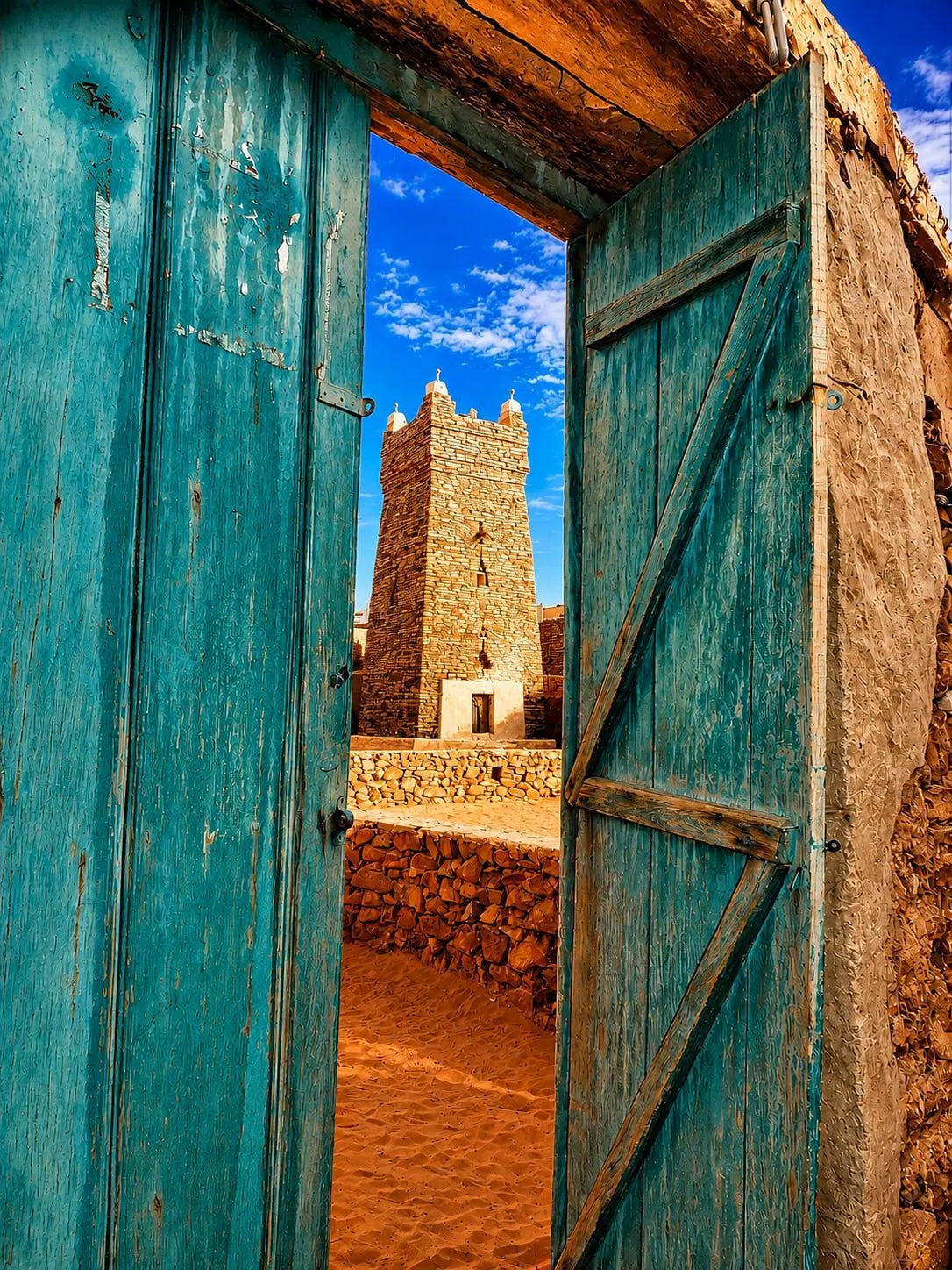
Mauritania’s historic ksour — ancient fortified towns built along caravan routes — remain among the country’s greatest treasures. These UNESCO World Heritage Sites were once centers of trade, religion, and scholarship.
- Chinguetti: The spiritual jewel of the Sahara, famous for its ancient libraries and as a major Islamic intellectual center.
- Ouadane: A great trading hub connected to the gold and salt trade, known for its striking stone architecture.
- Tichitt: One of the oldest continuously inhabited settlements in the Sahara.
- Oualata: A gateway between the Sahara and the Sahel, celebrated for its decorative architecture and scholars.
The Arrival and Expansion of Islam
Islam arrived in Mauritania between the 8th and 11th centuries, spreading primarily through commerce and scholarship. The Almoravid movement, which emerged in the 11th century, unified Saharan tribes and expanded its influence across North Africa and into Al-Andalus (Muslim Spain).
This era established Mauritania as an Islamic intellectual center. Traditional desert schools known as mahadras continue to train generations of scholars who memorize the Quran and study jurisprudence, astronomy, and philosophy in the silence of the Sahara.
Arab Migration and Moorish Society
Beginning in the 13th century, Arab tribes known as the Beni Hassan migrated into the region. Their influence led to the spread of Hassaniya Arabic and the blending of Arab and Berber traditions into the unique Moorish civilization that defines modern Mauritania.
Nomadic Life and Desert Culture
For most of its history, Mauritania was overwhelmingly nomadic. This lifestyle shaped every aspect of culture, from the hospitality offered to travelers to the rich poetic traditions that remain central to social life. Tea ceremonies, camel herding, and life in goat-hair tents became the hallmarks of Saharan identity.
Independence and Modern Nationhood
Mauritania gained independence from France in 1960. Under its first president, Moktar Ould Daddah, the nation began the transition from a nomadic society to a modern state. The severe droughts of the 1970s and 80s accelerated this change, leading to rapid urbanization and the growth of Nouakchott.
Today, Mauritania continues to balance its ancient heritage with modern development, leveraging its natural resources — iron ore, gold, fisheries, and natural gas — while preserving the timeless culture that has survived in the desert for millennia.
Conclusion
Mauritania is not simply a country of dunes and desert silence. It is a civilization shaped by movement, scholarship, trade, faith, and resilience — a timeless crossroads where Africa, the Arab world, and the Sahara meet.
Sources
- Wikipedia – History of Mauritania
- Mauritanian News Agency (AMI) – History of Mauritania
- BBC News – Mauritania Country Profile
- Exodus Africa – History of Mauritania
- Free Source Library – History of Mauritania From Ancient Times to Present
Written by
Wakaya Tours