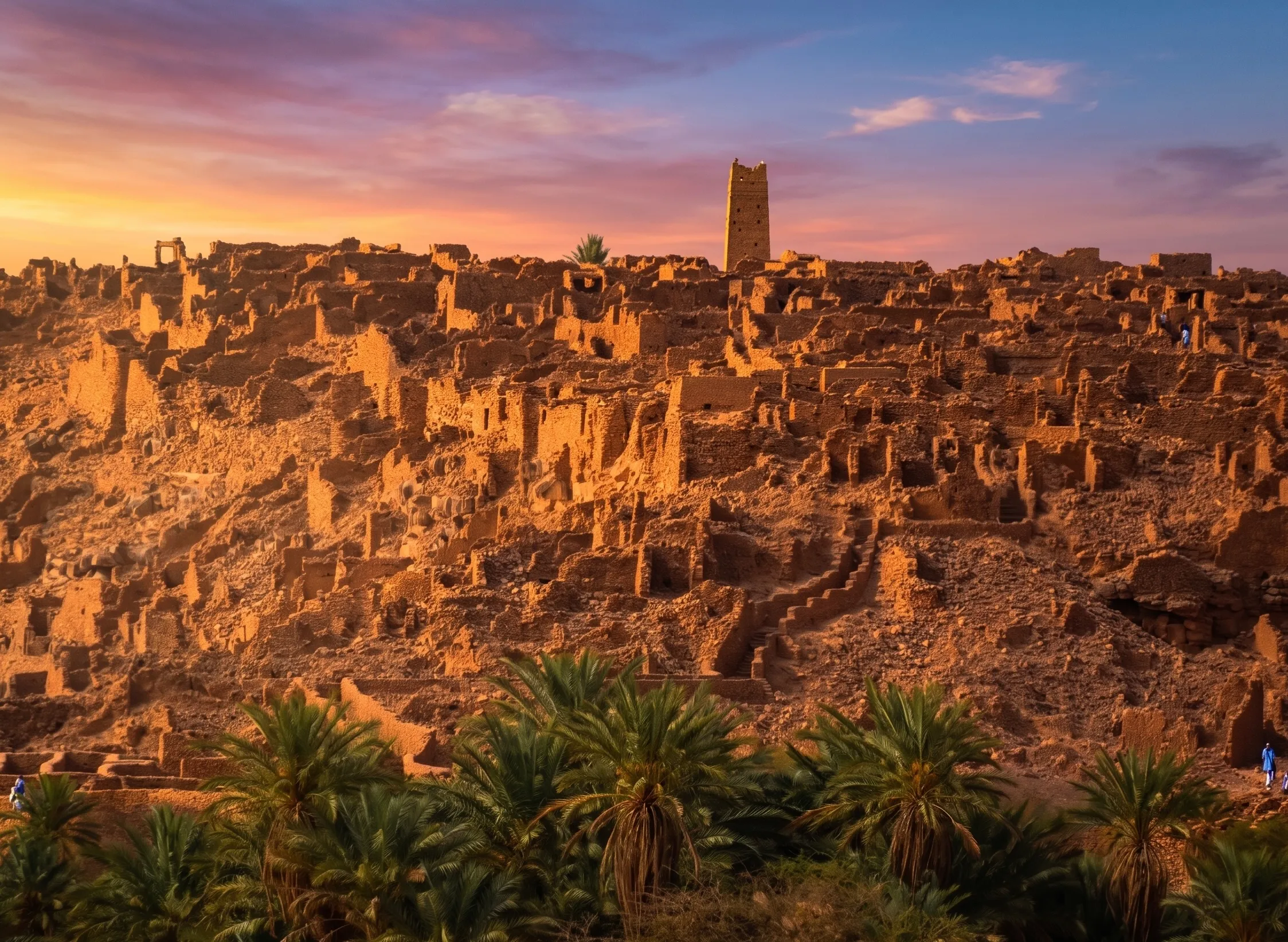
Ouadane: Mauritania’s Ancient Desert City and Gateway to the Sahara
Ouadane: Mauritania’s Ancient Desert City and Gateway to the Sahara
Deep in the Heart of the Sahara
Deep in the heart of Mauritania’s vast Sahara Desert lies one of West Africa’s most fascinating historical treasures: Ouadane. Once a thriving caravan city and center of Islamic scholarship, Ouadane stands today as a hauntingly beautiful reminder of the golden age of trans-Saharan trade. With its ancient stone ruins, winding alleyways, and proximity to the famous Richat Structure, Ouadane offers visitors a rare opportunity to step back into a forgotten chapter of Saharan history.
Recognized as a UNESCO World Heritage Site, this ancient ksar (fortified village) is one of Mauritania’s most important cultural landmarks and remains a symbol of resilience, trade, and scholarship in the desert.
A Historic City in the Heart of the Sahara
Ouadane is located on the southern edge of the Adrar Plateau, approximately 93 kilometers northeast of Chinguetti. Surrounded by rocky hills and golden sand dunes, the town occupied a strategic position along the historic caravan routes that linked North Africa to the kingdoms of West Africa.
Founded around the 12th century, Ouadane quickly became one of the most important trading centers in the Sahara. Caravans carrying gold, salt, ivory, and textiles passed through the city, transforming it into a bustling commercial crossroads. The city also played a major role in Islamic education, attracting scholars and students to study theology, astronomy, law, and mathematics.
The Golden Age of Trans-Saharan Trade
For centuries, the prosperity of Ouadane depended on the trans-Saharan trade network. One of the most valuable commodities was salt from the mines of Idjil. Massive slabs of salt were carried by camel caravans and exchanged for gold and other goods from West Africa. At its height, the city supported thousands of inhabitants and was a key node in the economic life of the desert.
A UNESCO World Heritage Site
Today, Ouadane is internationally recognized as part of the UNESCO-listed “Ancient Ksour of Ouadane, Chinguetti, Tichitt and Oualata.” These historic desert towns represent some of the finest surviving examples of medieval Saharan settlements.
Despite centuries of abandonment, much of Ouadane’s old city remains remarkably intact. Stone houses climb the hillside in dense clusters, connected by narrow streets designed to protect from the heat. The remains of ancient walls, watchtowers, and the 15th-century mosque showcase the architectural brilliance of medieval Saharan builders.
The Richat Structure: The Eye of the Sahara
One of the most extraordinary natural landmarks near Ouadane is the Richat Structure, often called the “Eye of the Sahara.” This massive circular geological formation measures approximately 40 to 50 kilometers in diameter and is visible from space.
While once thought to be a meteorite impact site, it is now understood to be a natural geological dome shaped by millions of years of erosion. Because Ouadane is the nearest settlement, many travelers use the ancient city as a base for exploring this unique natural wonder.
Decline and Preservation
Like many Saharan trading cities, Ouadane gradually declined as maritime trade routes replaced caravan commerce. By the 19th and 20th centuries, much of the population had moved, leaving the old city to be slowly consumed by the encroaching sands.
However, UNESCO recognition and local preservation efforts are working to protect this fragile heritage. Walking through the silent stone walls of Ouadane today, visitors can still feel the spirit of a city that once connected continents and shaped the history of the Sahara.
Visiting Ouadane Today
Traveling to Ouadane is an unforgettable experience for those interested in history and desert landscapes. Visitors can explore:
- The ancient ksar and stone ruins
- Historic mosques and defensive walls
- The Richat Structure (Eye of the Sahara)
- Traditional Mauritanian culture and hospitality
The best time to visit is between October and April, when temperatures are cooler.
Conclusion: A Living Legacy of the Sahara
Ouadane is a powerful symbol of Mauritania’s rich cultural heritage. Its ruins preserve the memory of a golden era where merchants and scholars crossed the desert, carrying knowledge and culture along with their goods. For travelers seeking authenticity and history, Ouadane remains one of Africa’s most fascinating hidden treasures.
Written by
Wakaya Tours