Oualata: Mauritania’s Painted Desert Jewel
Oualata: Mauritania’s Painted Desert Jewel and Ancient Gateway of the Sahara
The “Shore of Eternity”
Hidden deep in the southeastern deserts of Mauritania lies one of the Sahara’s most extraordinary historical treasures: Oualata. Known for its richly decorated mud-brick houses, ancient manuscript libraries, and centuries-old caravan history, Oualata stands as one of the most beautiful and culturally significant oasis towns in West Africa.
Often called the “Shore of Eternity,” Oualata connected the great empires of West Africa with North Africa and the Mediterranean world. Today, the ancient city continues to preserve a remarkable legacy of architecture, learning, and Saharan civilization.
A Legendary Oasis at the Edge of the Sahara
Oualata is located in southeastern Mauritania, at the eastern edge of the Aoukar Basin where the Sahel gradually merges into the Sahara Desert. Founded between the 11th and 12th centuries, it became an essential southern terminus of the trans-Saharan trade routes. Merchants crossing the desert brought gold, salt, ivory, textiles, and spices, making Oualata one of the Sahara’s richest commercial centers during the 13th and 14th centuries.
The Ancient City of Biru
Before becoming known as Oualata, the settlement was called “Biru” in the Mande language. It formed part of the powerful Ghana Empire and later the Mali Empire. Over time, Berber, Arab, Soninke, and Songhai influences blended together, creating a multicultural desert society shaped by trade, migration, and Islamic scholarship.
A Center of Islamic Scholarship
Like Chinguetti and Ouadane, Oualata became a major intellectual center. Family libraries preserved manuscripts covering Quranic sciences, law, astronomy, and poetry, some dating back to the 14th century. These libraries represent the broader intellectual history of the Islamic world in West Africa and continue to be protected by local families today.
Ibn Battuta and the Society of Oualata
The famous traveler Ibn Battuta visited Oualata in 1352 and provided one of the most valuable records of medieval life there. He was especially surprised by the social independence of women in Oualata, noting the significant respect they enjoyed and the matrilineal traditions where inheritance passed through the mother’s family.
Oualata’s Extraordinary Architecture
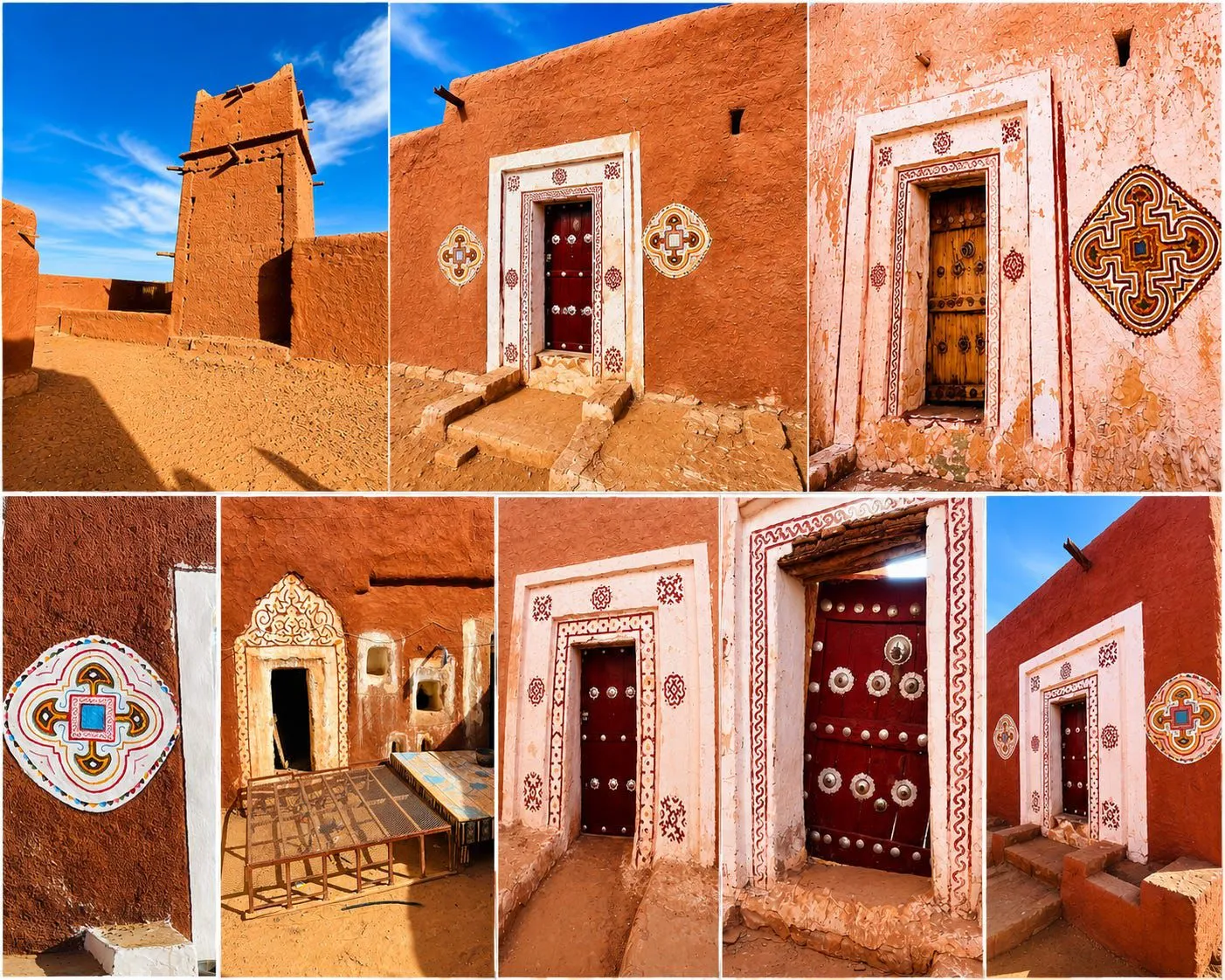
Oualata’s most distinctive feature is its breathtaking vernacular architecture. Unlike the stone-built towns of northern Mauritania, Oualata’s buildings are made from reddish mud-brick (banco).
The city is famous for its painted geometric facades, featuring intricate white and reddish motifs. These decorations are traditionally painted by women and passed down through generations. The architecture is also highly practical—the thick mud-brick walls keep the houses cool during the extreme desert heat.
UNESCO World Heritage Recognition
In 1996, UNESCO recognized Oualata as part of the “Ancient Ksour of Ouadane, Chinguetti, Tichitt and Oualata.” It was acknowledged for its exceptional preservation of medieval Saharan urban culture and its unique adaptation to the desert environment.
Desertification and Climate Threats
Today, Oualata faces serious threats from desertification. Encroaching dunes continue to bury parts of the city, and extreme weather damages the fragile mud-brick structures. Depopulation has also accelerated the town’s decline as younger generations leave for better opportunities, leaving many historic homes in ruins.
Visiting Oualata Today
Traveling to Oualata is an extraordinary adventure for those seeking authentic Saharan history. Because of its remote location, the journey is long, but the reward is a raw and genuine connection to the past. Visitors can explore:
- The painted mud-brick houses
- The ancient ksar and historic mosque
- The rare manuscript libraries
- Traditional Mauritanian hospitality
Conclusion: A Living Memory of the Desert
Oualata remains a symbol of Mauritania’s extraordinary cultural heritage. Its painted houses and manuscript collections preserve the memory of a civilization that connected continents through commerce and knowledge. For travelers and historians alike, Oualata is a journey into the living memory of the desert itself.
Written by
Wakaya Tours